

| By Ana Viñuales | CIDETEC Surface Engineering |
| In the current scenario of technological-digital transition, there is a growing demand for connected and interactive systems based on functionalized and/or sensorized surfaces. In this context, plastronics, also known as “in-mold electronics” (IME) is a new technology for manufacturing printed electronic devices incorporated in plastic materials, with high added value functions or features, increasingly demanded by sectors such as the automotive, white goods, health, packaging, etc. For example, it allows making switches without mechanical elements and having smooth surfaces integrating touch elements, sensors, lighting, antennas, etc. and improve human-machine interaction (HMI). The advantages that IME technology introduces compared to conventional silicon-based electronics are numerous, including: the elimination of mechanical switches, reducing both the number of parts and the complexity of the products; the reduction of the parts thickness (up to 80%) lightening the weight by up to 70% and allowing more functions to be offered in less space; the possibility of using organic materials, reducing the environmental impact, etc. The IME process consists of 4 main stages: – Printing functional inks on a plastic sheet to generate the circuits, sensor elements, etc. – Hybridization of rigid components (such as LEDs). – Thermoforming of the flat sheet to give it the desired shape. – Over-injection of the sheet with a plastic material, thus obtaining the final piece. CIDETEC Surface Engineering, as an international reference centre for research and innovation related to surface engineering and polymeric materials, has more than 15 years of experience in 2D printed electronics. In the current scenario, CIDETEC is going one step further and is investing in IME technology, equipping itself with strategic equipment and acquiring in-depth knowledge of all stages of the process, with a special focus on the high-pressure thermoforming phase, a much more recent and advanced technique that offers extremely high precision and operates at lower temperatures than other conventional thermoforming techniques, allowing the use of a greater variety of materials. To this end, CIDETEC has recently acquired a high-pressure thermoforming unit from NIEBLING (model SAMK 720), the leading brand in this technology worldwide. CIDETEC thus becomes the 5th R&D centre in Europe to have this unique equipment, which will contribute to the positioning of the centre and the Basque Country, placing them at the forefront in the field of printed electronics/IME. The objective is to develop R&D projects that allow us to acquire in-depth knowledge of how the process affects different materials (plastic sheets and printed conductive inks) and to manufacture prototypes with embedded electronics for future technology transfer to companies that require this type of products, mainly in the automotive sector. |
blog
Egoitz Luis Monasterio, Business Development Manager for Automotive at CIDETEC Surface Engineering, discusses the center’s capabilities in In-Mold Electronics, covering the entire value chain to meet the demands of a rapidly growing market driven by electric and connected vehicles, while also expanding into new sectors. The recently acquired NIEBLING SAMK 720 high-pressure thermoforming equipment at CIDETEC Surface Engineering is the only one of its kind in the country.
| Por Elixabete Ayerbe | Team Leader del Equipo de Modelización y Postmortem Analysis |
| |
| This movement is further supported by the digital wave, where automation, artificial intelligence, and data analytics contribute to the acceleration of new developments. In this regard, CIDETEC Energy Storage has long been committed to the development and implementation of digital solutions to advance battery technologies. Recently, it launched the digital platform PROTEO, which accelerates cell development and marks a significant milestone in innovation and efficiency within the energy sector. PROTEO, based on multiphysics models, artificial intelligence, and a dynamic database, offers a revolutionary approach to the construction, testing, and optimization of cells. The platform consists of three modules: PROTEO Design, based on thermo-electrochemical-mechanical models, allows users to virtually design and optimize cells from scratch, providing insights into cell design, identifying optimal conditions for SEI formation, and detecting potential failure modes throughout their lifespan PROTEO Prediction, supported by AI, predicts the lifespan of a battery cell based on electrode characteristics, cell design, and usage profiles, accelerating the testing and validation phase PROTEO Data Analytics, which automatically collects data from various sources for efficient management and visualization. |
The Department of Sustainability of the Gipuzkoa Provincial Council and CIDETEC, in collaboration with the NATURKLIMA Foundation, will launch in the Eskuzaitzeta industrial area:
• A Laboratory for Characterizing Recycled Materials from Used Batteries.
• Implementation of a State-of-the-Art Energy Microgrid in the Eskuzaitzeta Business Environment. Oscar Miguel, Deputy Director of CIDETEC Energy Storage, tells us the general lines of this agreement that positions the territory at the forefront of the circular economy and energy transition.
Dra. Marta Fenero, investigadora de CIDETEC Surface Engineering, presenta algunas de las soluciones que los desarrollos omnifóbicos de CIDETEC Surface Engineering han ofrecido a sectores como el aeronáutico o el energético. Todas ellas, extrapolables a otros ámbitos, gracias a la capacidad de escalado de CIDETEC, con el objetivo de lograr una mayor eficiencia y una reducción en costes de mantenimiento.
Hablan nuestros expertos:

Dr. Chihab Abarkane
Unidad de Coatings y Tratamientos de Superficies
¿La Emisión Acústica como herramienta de prevención de accidentes? La respuesta es sí.
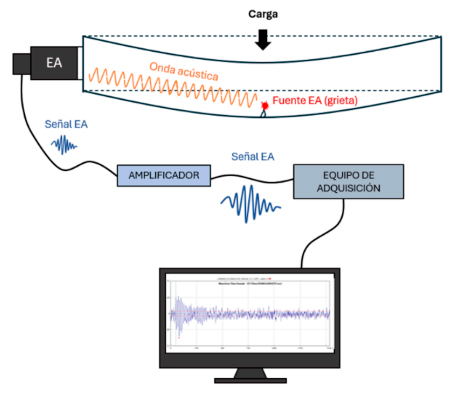
La emisión acústica (EA) es una técnica no destructiva que sirve para hacer un seguimiento en tiempo real del estado de integridad de un material. Es decir, nos permite conocer lo que está ocurriendo en el interior de una estructura antes de que sea visible al ojo humano. Por ejemplo, podemos detectar la fisuración del hormigón en un tablero que soporta un puente., ya que dicha deformación mecánica libera ondas acústicas que se propagan por el material.
La EA nos permite registrar las ondas acústicas emitidas por un material a través de un sensor piezoeléctrico acoplado a la superficie que las transforma en señales de voltaje. A su vez, estas son procesadas por un equipo de adquisición con el fin de obtener información sobre el material y la degradación que sufre (por ejemplo, fisuras o grietas en el hormigón).
El principio de la técnica se basa en la captación de las ondas acústicas emitidas por un material a través de un sensor piezoeléctrico acoplado a la superficie que las transforma en señales de voltaje. Éstas, a su vez, son procesadas por un equipo de adquisición con el fin de obtener información sobre el material y la degradación que sufre.
La técnica de EA nos permite:
- Detección temprana de la degradación: las ondas acústicas son liberadas desde el inicio de la degradación y podemos detectarlas en tiempo real.
- Seguimiento integral de la estructura, debido a que las ondas se propagan en todas las direcciones y pueden detectarse desde cualquier superficie.
- Detección en condiciones de servicio gracias al procesamiento de señales que permite filtrar las ondas acústicas que provengan de procesos ajenos al mecanismo de degradación de interés.
¿Cómo aplicar la EA?
CIDETEC Surface Engineering ha habilitado la técnica de Emisión Acústica siguiendo el siguiente proceso:
- Reproducimos el mecanismo de interés en condiciones controladas.
- Caracterizamos su alcance y evolución
- Analizamos las ondas acústicas registradas (señales) para identificar y caracterizar aquellas que proceden de dicha degradación.
- Con los resultados obtenidos, construimos un sistema de filtrado para monitorizar el mecanismo de degradación en una estructura durante su tiempo de servicio.
De este modo, somos capaces de implementar una medida de prevención detectando una degradación desde su origen, y solucionándola antes de que tenga consecuencias negativas. Por ejemplo, se podrían instalar sensores de EA en el tablero de un puente, y detectar así la fisuración de hormigón de forma temprana, lo que permitiría emprender acciones preventivas de mantenimiento y alargar su vida útil.
CIDETEC Surface Engineering acogerá el ‘Surface Treatments Pilot Lines workshop’
Se celebrará los días 23 y 24 de abril en Donostia-San Sebastián y la inscripción gratuita está ya abierta en la web del evento.